



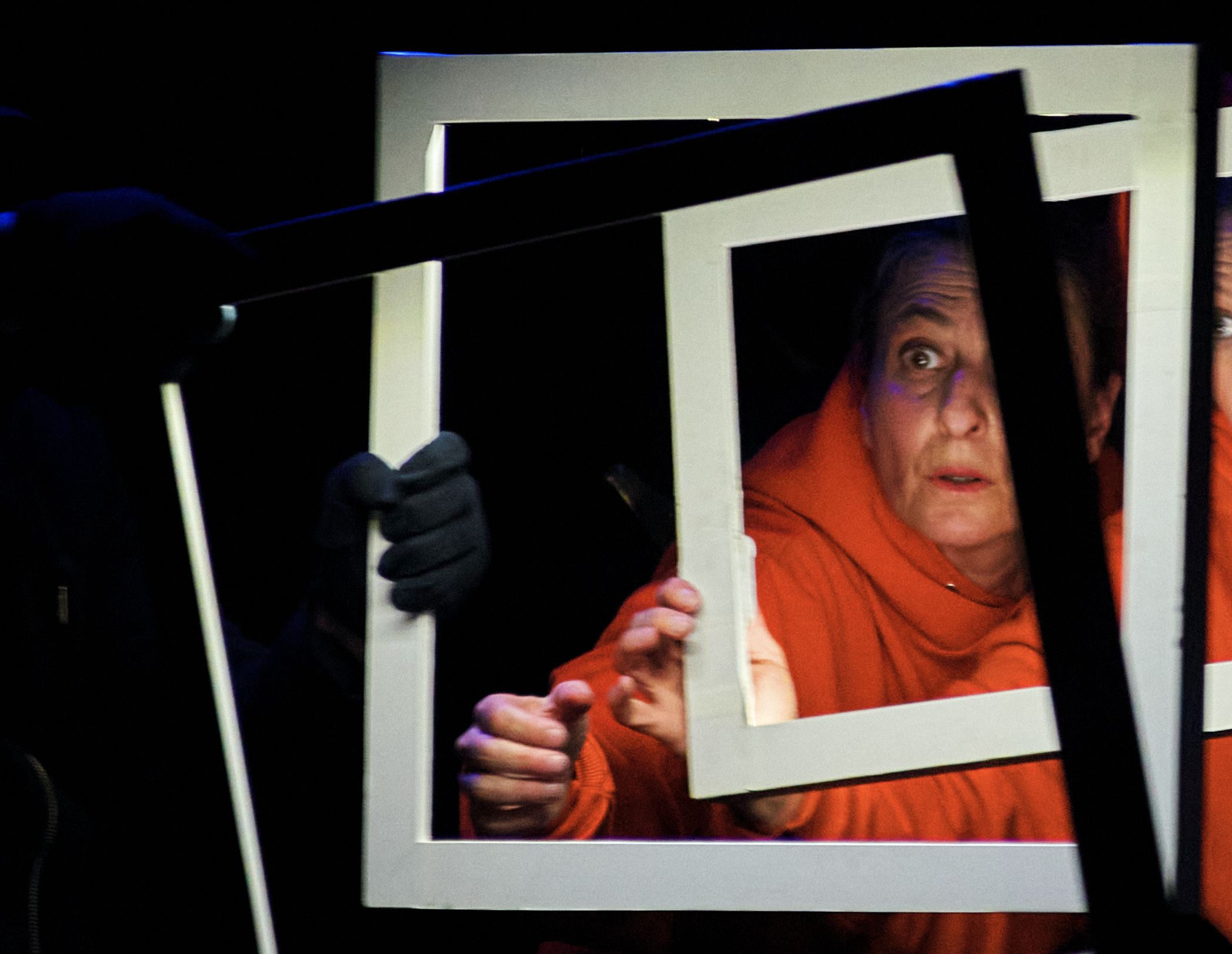
Transhumanism, artificial intelligence, social media, augmented reality — multiple realities unfolding at once — growing up surrounded by loneliness and insecurity, anxiety as a permanent and almost ordinary state of mind: these were the themes explored in the French production Alice in the Wonder Box, performed by the company Mangano–Massip.
Through an inventive use of theatrical forms, techniques, and technologies, the audience witnessed a disturbing vision of the world toward which we seem to be rushing. After the performance, Sara Mangano — co-author, co-director, and one of the Alices in the piece, alongside Pierre-Yves Massip — spoke about these questions in depth. Mangano and Massip both trained with the legendary Marcel Marceau, which is where our conversation began.
What is the most important thing Marcel Marceau taught you?
He taught us the poetry of movement — that poetry lives within every human gesture, and that it simply has to be discovered. Poetry, in fact, exists in everything; it is up to us to find it. Another very important lesson we carried from his school was breathing: the importance of breath, and understanding the relationship between breathing, movement, the body, and the poetry of movement and thought.
In Alice, you explored the anxious emotional climate experienced by young people today, especially in relation to the parallel realities created by social media. How do you personally feel about this theme, which you approached through the perspective of teenagers?
This subject is extremely important to me — it is one of the defining themes of our time. It speaks about how things are changing through new technologies and the way they gradually take over our lives, occupying all available space within them. We are flesh-and-blood human beings, and we tried to bring that onto the stage — to explore how the human body exists in space in relation to these technologies and the obsessive way they seize our attention, our will, all of our senses. New technologies are here; they are a fact of our lives, and we have to investigate their influence on us.
In the performance we used them primarily as a metaphor, while at the same time relying on the body itself and reflecting on the relationship between the two. The masks and puppets were simply tools that allowed us to sharpen the story further.
In the performance, the body — the person, the human being — becomes a commodity from an early age. Today everything is merchandise. Does that frighten you?
I’m not a mother, but I know teenagers, and it is deeply disturbing to see how their world, their lives, are being taken away from them. Young people are so consumed by their phones that almost nothing outside of them seems meaningful anymore. It makes me profoundly sad. They are young and often unable to perceive the system behind all of this — the system that is taking away their freedom. New technologies are leading us toward the complete loss of freedom. Their purpose is to make us buy, buy, and keep buying. Capitalism, ultimately. We are all becoming commodities. Of course that frightens me.
First they rent our minds, only to occupy them completely and eventually purchase them. That is why it is so important to limit our use of these technologies, to train ourselves to use them only during certain parts of the day, so that they do not become our modus vivendi. Otherwise we will completely lose our sense of reality — and before that, our connection with one another. People often say that technologies connect us. Yes, but they also disconnect us. Perhaps they disconnect even more than they connect.
How do you choose the themes for your performances?
We choose the things that obsess us, and what obsesses us most are fears — all kinds of fears, small and large, justified and unjustified. We are filled with fear because we are constantly being frightened. The societies we live in operate through fear. Fear parasitizes each of us, and it is very easy to ignite it within us, to make it flare up. This era knows how to do that quickly and efficiently. We are even genetically infused with fear — fear of what will remain after us — and throughout our lives we are always afraid of something, sometimes to the point that fear paralyzes us and clouds our minds.
As life goes on, some fears prove justified: we lose many things, we lose people we love, slowly we lose our bodies, our attention, our concentration; our senses begin to fail us, and eventually even our reason.
So it is difficult to inhabit one’s own body, sometimes as difficult as inhabiting reality itself. Is there courage in French theatre today to speak openly about these things?
There is courage to speak about many important things, but it is true that over the last several years the situation in French culture has changed. Culture is no longer considered as important as it once was. Politically, things have shifted. Support is often absent. New municipal administrations, which once supported culture, have now decided to sever the ties they had built and maintained with it.
Why? Because the people who create that culture are often not politically aligned with them — they do not support their political agenda. It takes great courage to continue making theatre, to say what must be said, because what is happening is obvious.