



The World at Hand
When they are very young, most children encounter their first puppet theatre through a mother, grandmother, or another caring adult: a tiny performance played on the palm of a hand. Many of us grew up with finger-play rhymes in which each finger became a little character in an improvised miniature theatre. That childhood gift — storytelling through hands and fingers — remains deeply rooted within us. The non-verbal performance Sha Doizo by Le Friiix Club, created by Frédéric Féliciano for toddlers, builds precisely on this idea, transforming hands and fingers into living puppets.
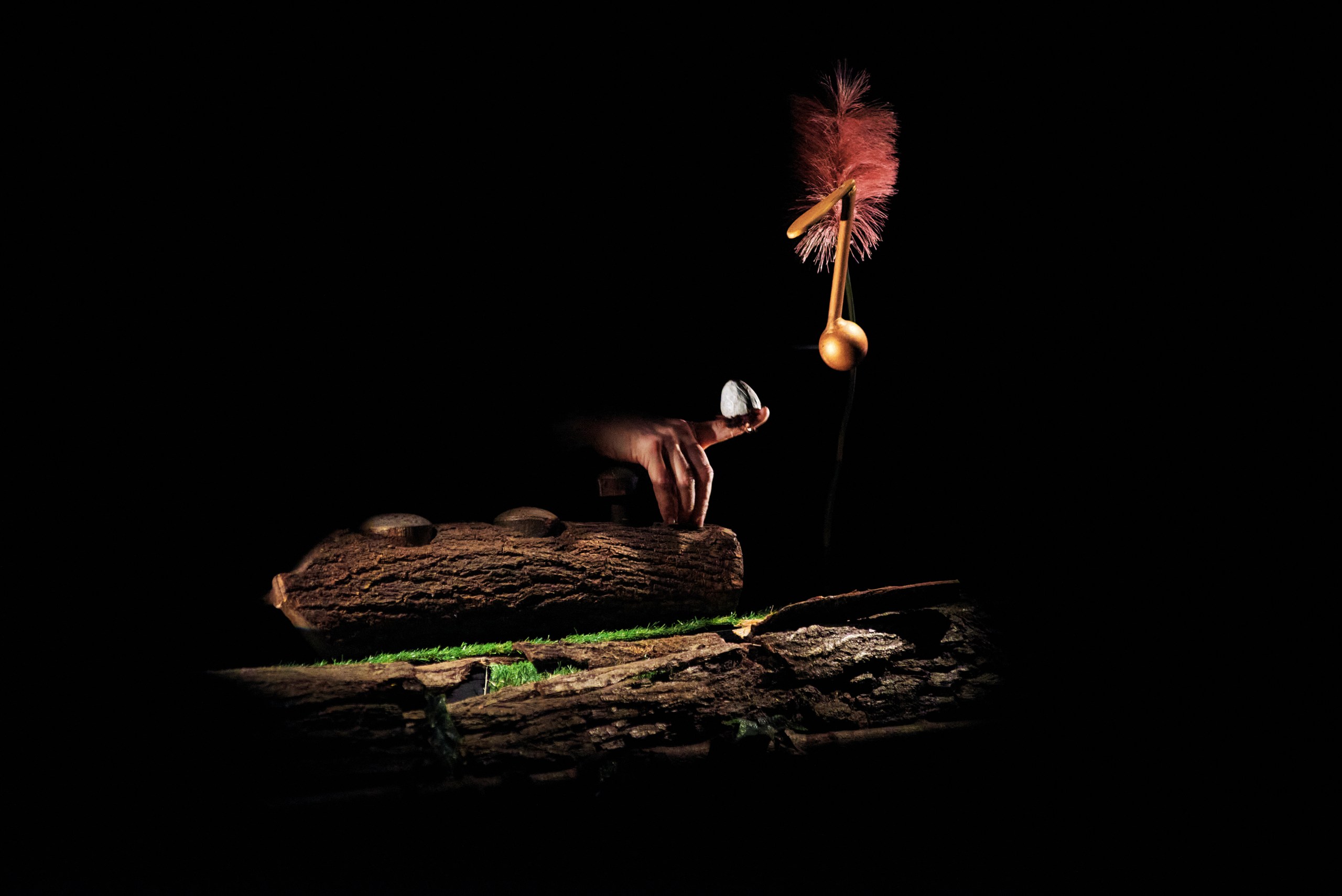
An audience whose age is still measured mostly in months rather than years — and for whom this is likely a first encounter with theatre — watches a sequence of scenic images set in nature. A tiny creature hatches from an egg, a snake catches a butterfly, spiders weave their webs, the Moon rises, two mushrooms dance, and a small being hears and follows music embodied by a bouncing musical note. The title itself is a hybrid of the French words for cat and bird, so the entire piece may be understood as a kind of bird-cat observing the movements of various creatures in the garden in order to discover its own movement. Some creatures fly, hop, slither, or crawl; others simply emerge and glide across the sky like the Moon or fall like shooting stars. There are also those, like flowers rooted to the earth, whose movement resembles swaying in the wind or trembling when shaken by a snake, while music — represented by the note — simply spreads throughout the garden.
By observing and imitating the creatures around it, the small being gradually discovers different ways of moving through the world. In doing so, the performance introduces its young audience to some of the most fundamental experiences and concepts: birth, movement, musical rhythm, and the alternation of day and night. This is, of course, only one possible way of connecting the performance’s associative images into a larger narrative. The piece itself resists any single fixed interpretation, leaving space for free association and individual meaning-making. Most scenes are brief, each built around the exploration of a particular movement or creature before gently shifting to the next. Still, one cannot help feeling that the dramaturgy might have benefited from a firmer structure, as the central premise seemed rich enough to sustain a more clearly developed narrative arc.
The visual enchantment of the performance arises from its consistent use of black theatre technique, in which complete darkness allows hands and objects to become the sole focus of light and attention. Thanks to Erwan Costadau’s precise lighting design, the performer’s body remains invisible, creating the uncanny impression that shapes and creatures are floating up out of darkness itself. The effect is hypnotic, stripping away unnecessary distractions and directing the audience’s still newly awakened curiosity toward pure visual symbols — a glowing musical note, the Moon, flickering wings — as well as toward the remarkable precision and expressiveness of the animated fingers themselves. Yet while the constant darkness can be mesmerizing, it may also feel slightly intimidating. The effect would likely have been even stronger had the audience been seated closer to the stage.
Through the play of palms and fingers, Sha Doizo reminds its youngest spectators that play is always close at hand, and that the world around us remains a place of endless wonder. The performance shows how even a part of our own body can spark the imagination, and how nurturing childlike curiosity through attentive observation of the living world can lead us toward a deeper understanding of ourselves, of movement, and of the life that surrounds us. Perhaps that is the greatest gift puppetry can offer.