



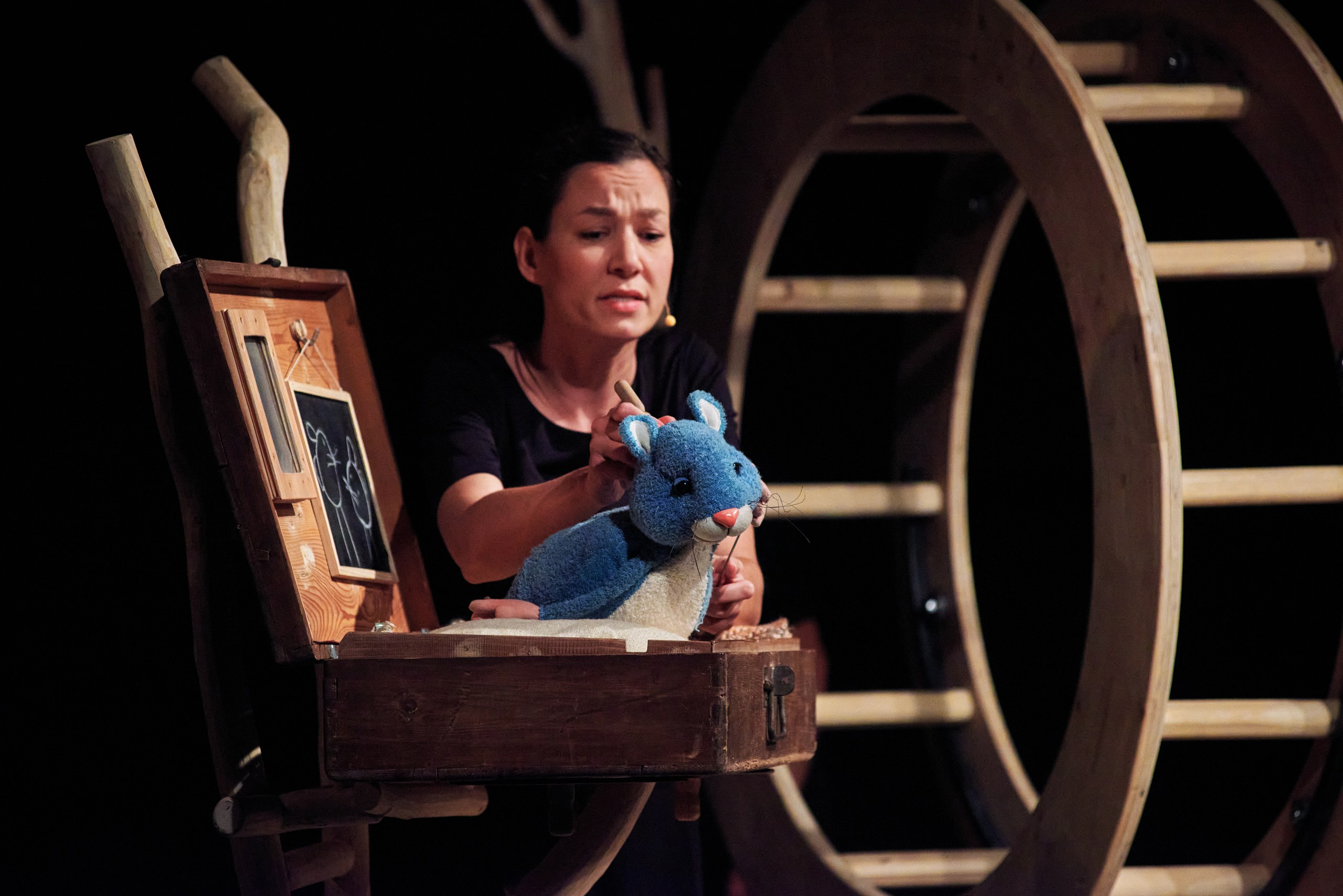
Sweet words are not born in silence — above all, they are born through sharing, through hugs, and through understanding. That is the message conveyed by the wonderful Rijeka actors David Petrović, Tilen Kožamelj, and Petra Šarac, who — and “brilliantly” hardly seems enough — delivered a masterful performance of Sweet Words, produced by their home theatre, the Rijeka City Puppet Theatre.
They moved almost the entire audience to tears, and the crowd rewarded them with thunderous applause, cries of “bravo,” and a long standing ovation, refusing to let them leave the stage. In the five-year history of the Novi Sad Theatre Festival, no performance has ever been received like this — and we have seen some truly exceptional productions. Simply put: blessed are the childhoods shaped by performances from this Rijeka theatre, and by theatre like this in general.
Although every actor shone in the story of little hamster Lola, her parents, brother, friend, and crush, it was actress Petra Šarac who spoke after the performance about the tenderness and attentiveness at the heart of Sweet Words. Clearly moved herself by the audience’s reaction in Novi Sad, she reminded us — through the delicacy of her acting and her words — what an incredibly beautiful feeling it is to be gentle and kind.
During your childhood, where and how did you find those important “sweet words”?
I grew up in Osijek, right across from the Children’s Theatre. Every weekend, my mother, my brother, and I went to the theatre. We watched every production twenty times over. We had our own seats, we knew all the actors, and some of them retired recently, which made me feel as though my childhood had retired too.
What I especially remember is that after every performance my mother would talk to us about what we had watched — exactly the way discussions are held after performances here at the Novi Sad Theatre Festival. She would ask us what mattered to us, what did not, what was beautiful and what was not, what lesson we could take away, what we had learned from the play.
My mother was very aware of how important that was, but I worry whether parents today — especially surrounded by so much technology — can remain equally aware, because the easiest way to entertain a child is simply to hand them a phone. And in that way, human contact gets lost, that living exchange of emotions and thoughts.
I think the value of our play lies precisely in the fact that it reminds us of the importance of human communication. If parents remember how important conversation, tenderness, and attentiveness are, and begin to practice them themselves, then children — who absorb everything like sponges and intuitively feel everything — will begin to behave that way too. I think we adults are the ones who really struggle with this.
Which “sweet words” are important to say today in the theatre, among colleagues and collaborators? What is important to say out loud?
“Sorry.” That word is very important to me.
I see that people find it incredibly difficult to say because they experience it as some kind of defeat. I do not know why apologizing and admitting mistakes is so difficult, because mistakes are actually pathways toward becoming better.
If you make a mistake and someone points it out to you, then you correct it, and next time you will not repeat it. That means you become better and wiser than before. Every “I’m sorry” helps shape me into a better person.
The theatre world generally involves a lot of ego, but people often do not handle it properly, which is why we end up in unhealthy situations. And yet the simplest and most beautiful thing would often be to say: “I’m sorry,” “I don’t know,” “Help me…”
Does that mean ego is smaller outside the theatre?
I would not say it is smaller. It is just that I somehow live theatre, and most of the people I spend time with outside the theatre are theatre people too, so it matters to me that those relationships remain healthy — especially because so many relationships around us, everywhere, are poisoned by ego.
At the same time, ego can also be healthy — in the right measure and when directed properly. But the line between healthy and unhealthy ego is very thin. Every day, a person has to evaluate themselves, constantly work on themselves, and that process never really ends.
We should always try to be better today than we were yesterday, and better tomorrow than we are today.
As actors, you are in direct contact with the audience — you can feel them, see how they breathe, how they react. Can actors in your theatre influence the choice of themes and plays you work on?
Not really. No one actually asks us about that. But we are lucky because our director is very aware of what is important for us to stage and when the right moment is to put on a certain text.
We also have a wonderful artistic director who brings us extraordinary people, beautiful texts, important themes, and meaningful messages. Then all of us together try to collaborate well and create something valuable.
I feel that our theatre is still, somehow, a sanctuary of peace. We still love the theatre within us, rather than ourselves within the theatre.
At one point in the play you say that sweet words are not born in silence, but in sharing. Yet silence is also deeply necessary for a person to connect with themselves. Where do you find those silences?
I absolutely agree that silence is necessary. I find it in nature, during walks with my dog Mona, who is an angel. She is everything that I am not, and it is incredible how deeply a person can connect with a living being that does not have a highly developed intellect and with whom you cannot communicate verbally.
She was actually one of the inspirations for the character of little hamster Lola — or rather, Mona’s warmth, tenderness, and ability to forgive, to forget, to move on from everything. She is someone who reminds me how to be human.
Top of Form
Bottom of Form