



In Fellini’s Nights of Cabiria, a character says: “All of us can pretend to be cynical, mysterious, and cunning, but when we are confronted with purity and tenderness, the mask falls away on its own.” After watching Sweet Words by the Rijeka City Puppet Theatre, there was not a single audience member whose mask remained intact. It is such a spontaneous, warm, and tender performance.
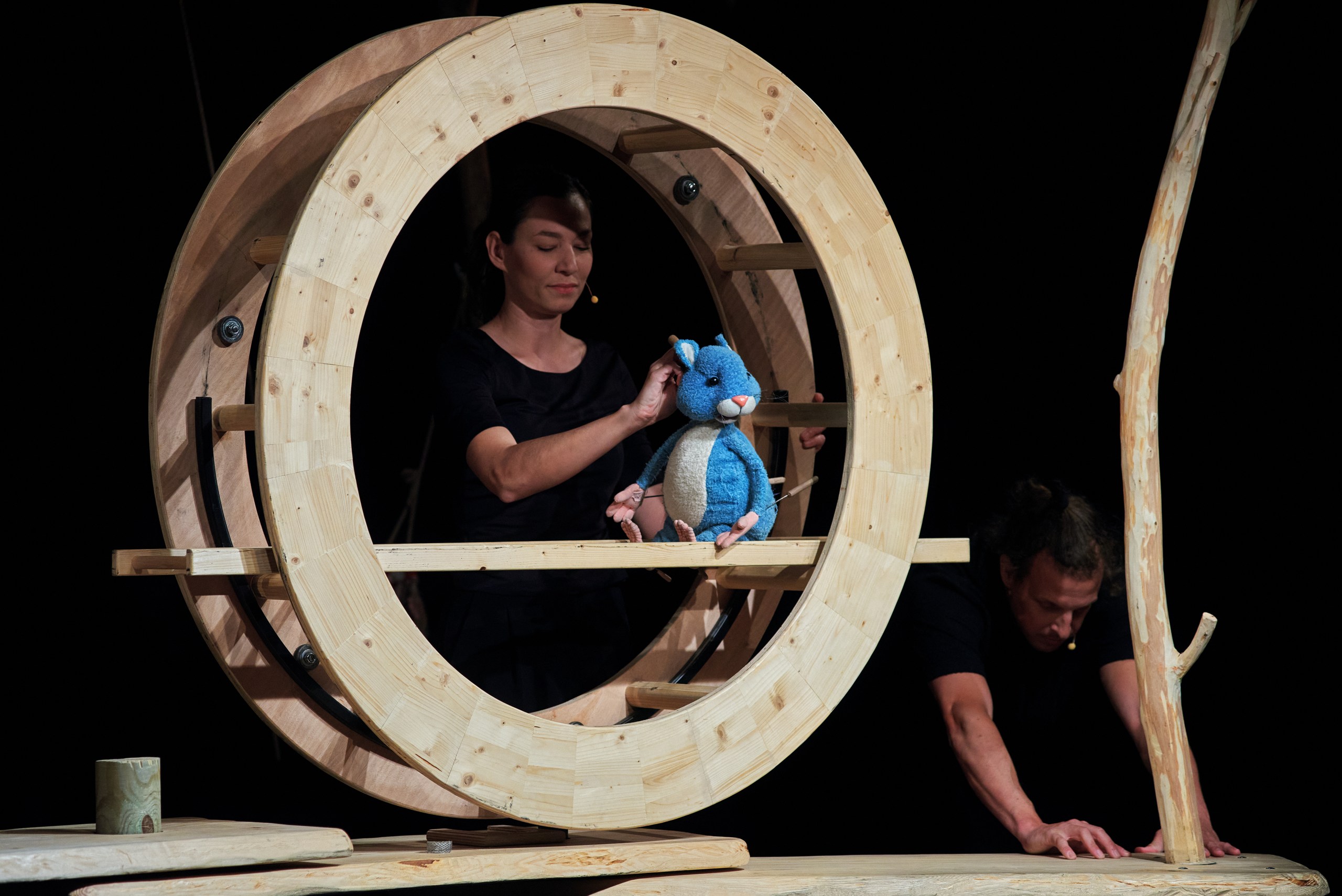
Sweet Words, directed by Mateja Bizjak Petit and based on Carl Norac’s picture book I Love You So Much, is performed by the brilliant puppeteer-actors Tilen Kožamelj, Petra Šarac, and David Petrović — precise, agile, and wonderfully expressive. Lola, like any proper hamster, has chubby cheeks, but hers have not swollen from storing hazelnuts and apples. Instead, they are filled with kind words she longs to share with others.
Her mother and father are busy, her teacher is always in a rush, her crush is trying to act cool, her brother is uninterested, and the people on the bus are rude. No one has time to listen, let alone return sweet words. Even after she gets a small and a large box for storing little and big happiness, she continues to face teasing and ridicule from both her crush and her brother. Yet little Lola does not give up, and from her cheeks spill sweet words — from a simple “good morning” to “I love you” — addressed to everyone, even those who are too busy or too distracted to notice the goodness and kindness around them.
This brings us to the ending and to the song heard throughout the play: “We children know, love is our strength” (music by Damien Felix). Love — and the need, ability, and courage to express it, receive it, and return it — makes children (and hamsters) far stronger than they realize.
Beyond being touching, sincere, and emotionally disarming enough to soften even the most cynical among us, the performance is also full of humor. There are witty lines during the math lesson, amusing reactions from Lola’s brother when he receives a globe, the hilariously blaring bus horn, and the comic hip-hop performance by Lola’s crush. The rapid pace and masterful puppetry of all three performers add enormously to the comedy. One moment the audience bursts into laughter, the next we are confronted with Lola’s sincere confusion about why sweet words matter so much. In this way, the production completely avoids any trace of didacticism. It communicates lessons about kindness, language, and human connection, yet thanks to its excellent rhythm, it never feels as though those lessons are being imposed from a position of authority.
From a dramaturgical perspective, viewers whose own cheeks are not filled with sweet words might perhaps notice a few minor shortcomings — or at least unanswered questions regarding certain characters’ motivations (for example, why Lola’s brother suddenly decides to apologize). Yet this does not affect the strength or flow of the story in the slightest. The production offers guidance and gentle suggestions about positive behavior, entirely appropriate for its intended age group (3+).
Language functions not only as the carrier of “sweet words,” but also as a tool for creating rhythm within the performance itself — for instance, while Lola walks inside her running wheel. The scenography (total design by Luči Vidanović) creates a safe and playful environment dominated by oversized everyday hamster objects: a wheel, ladders, and a tree. The running wheel itself becomes an image of Lola’s endless and often futile search for someone willing to truly listen. The puppets of Lola and her brother (the same puppet also doubles as the crush and a friend) are rendered three-dimensionally, while the parents appear only as flat illustrated heads — a subtle sign of their frequent absence or half-presence in Lola’s life.
Sweet Words confronts us with what is purest, most alive, and most delicate within ourselves. Not only did it make our masks of bitterness and cynicism fall away, it also made us wonder whether we should wear them at all. And why would we? Little hamster Lola is far happier when she notices and shares love.